
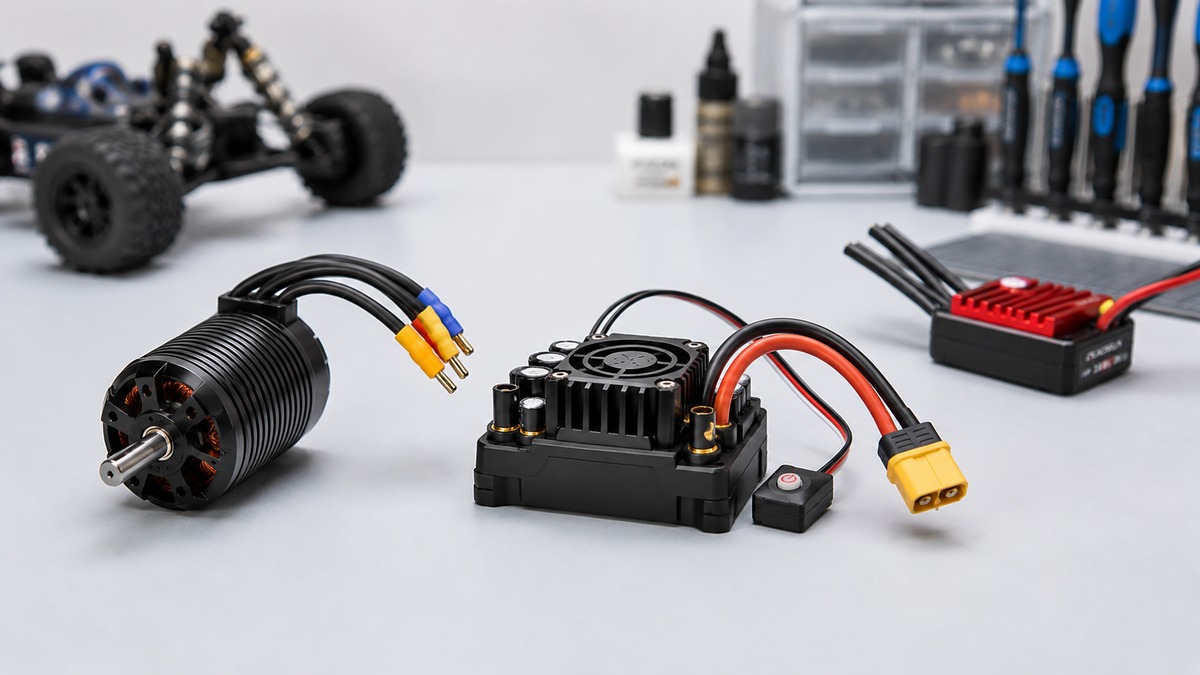
How to Match an RC Motor to Your ESC Without Guessing
Intro
Motor and ESC mismatch is one of the fastest ways to build a rig that runs hot, feels weak, or dies early.
The good news is you do not need to guess. A few compatibility checks will tell you pretty quickly whether the combo makes sense.
The Core Idea (In Plain English)
Matching a motor to an ESC means making sure the two parts agree on the basics before you ever pull the trigger.
Start with the obvious one: brushed motors need a brushed ESC, and brushless motors need a brushless ESC. After that, look at amp rating, supported battery voltage, and the kind of motor you are trying to run. A high-KV brushless setup on too small an ESC is asking for heat and stress. A hotter low-turn brushed motor on a mild ESC can do the same thing. If you still need the quick split between motor types, Brushed vs Brushless Motors is the first box to check.
In plain English, the ESC has to be able to safely feed the motor the power it wants, on the battery voltage you plan to run, without cooking itself.
When This Matters (Use Cases)
Scenario 1
You drop a higher-KV brushless motor into a basher because you want more speed, but keep the same small ESC.
Now the truck runs hotter, the ESC fan never stops, and the whole setup feels more stressed than fast.
Scenario 2
You are refreshing an older brushed truck and want to try a hotter motor, but you are not sure whether the stock ESC can handle it.
That is where turns and current draw matter. Hotter brushed motors ask more from the ESC than mild stock cans do.
Scenario 3
You buy a motor and ESC from different brands and the specs look close enough, but the battery plugs, bullet connectors, and voltage ratings do not line up cleanly.
That is how simple installs turn into adapter stacks, heat, and avoidable headaches.
What to Look For / Key Considerations
- Brushed motors only work with brushed ESCs
- Brushless motors only work with brushless ESCs
- ESC amp rating needs enough headroom for the motor and the way you drive
- Battery cell count has to be supported by both the ESC and the motor setup
- Higher KV or hotter turns usually raise current draw and heat
- Gearing can turn a safe combo into a hot combo fast
- Connector and bullet plug compatibility matters more than people think
- Manufacturer limits are there for a reason, especially on voltage and motor size
Common Mistakes
- Mixing brushed and brushless parts
- Assuming any ESC can handle any hotter motor
- Ignoring voltage limits and running too many cells
- Gearing up and blaming the ESC when temperatures spike
- Using adapters and mismatched connectors as a permanent solution
- Skipping manufacturer ratings because the setup "mostly works"
Real Talk
Most bad motor and ESC combos are not bad luck.
They are usually a spec-sheet problem that got ignored on the bench and showed up as heat on the ground.
Keep Your Rig Dialed
- Use the Parts Finder to find parts that fit your exact RC
- If you already know the category you need, browse related parts and upgrades
- Learn more in Brushed vs Brushless Motors
- Keep dialing it in with RC Motor Temperature Guide
Closing
Match the motor type, current demand, voltage, and connectors first.
Do that part right, and the rest of the setup gets a whole lot easier to trust.