
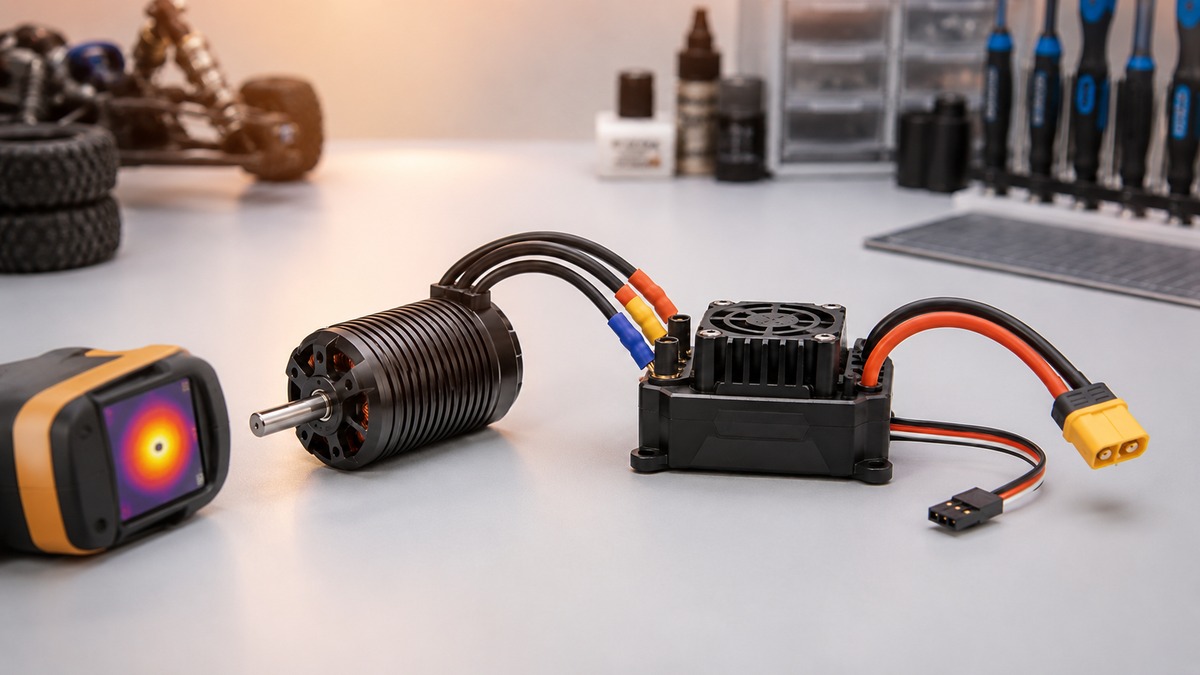
RC Motor Temperature Guide: How Hot Is Too Hot?
Intro
If your motor is too hot to touch for more than a second or two, your RC is trying to tell you something.
Heat is one of the fastest ways to turn a fun setup into a frustrating one. Power drops off, runtime suffers, and parts wear out quicker than they should.
The good news is most overheating problems are fixable once you know what to watch for.
The Core Idea (In Plain English)
RC motors and ESCs make heat every time you drive. That part is normal.
The problem starts when they make more heat than the system can get rid of.
As a simple rule, warm is fine. Hot enough that you are worried every run is not. For a lot of setups, keeping motor temps in a reasonable range matters more than chasing one magic number. If temps keep climbing after short runs, you have a setup issue to solve.
Heat usually shows up from a few common causes:
- Gearing that is too aggressive
- Big tires or heavy drivetrains
- Poor airflow around the motor and ESC
- Hard driving in grass, deep dirt, or high-traction surfaces
- A setup that just is not balanced for the power you are asking from it
That is why temperature checks and basic maintenance go together. If your drivetrain is dirty or binding, the extra drag can raise heat fast.
Battery setup matters too. More voltage and extra load can make a heat problem show up a whole lot faster. If the drivetrain also sounds rough or noisy, gear mesh belongs on your shortlist too.
When This Matters (Use Cases)
Scenario 1
- You geared up for more speed and now the motor comes back way hotter than before
- More top speed sounds great until the system starts cooking itself every run
Scenario 2
- You bash in grass, loose dirt, or on hot pavement
- Those surfaces load the drivetrain harder and can make a normally fine setup run hot in a hurry
Scenario 3
- You upgraded batteries, tires, or power systems all at once
- Small changes stack up, and heat is often the first sign that the setup is out of balance
What to Look For / Key Considerations
- Check temperatures after short runs instead of waiting until the whole pack is done
- Watch both the motor and ESC because heat problems rarely stay in one place
- Gear down if temps rise quickly after a pinion or tire change
- Make sure the motor area and ESC fan have decent airflow
- Clean dirt and debris away from cooling fins, fans, and moving parts
- Remember that bigger tires add load even if you never change the pinion gear
- Pay attention to driving style because repeated full-throttle pulls build heat faster than most people think
- Use the same surface and battery when comparing setup changes so your temp checks actually mean something
Common Mistakes
- Assuming hot is normal just because the car is fast
- Making multiple setup changes at once and guessing which one caused the heat
- Ignoring ESC temps while only checking the motor
- Gearing up before the rest of the drivetrain is ready for it
- Running through grass all day and comparing temps to smooth pavement runs
Real Talk
A lot of heat problems come from chasing a setup that looks exciting on paper.
More gear, more tire, more battery, more speed. Then suddenly the whole system runs angry.
A slightly slower car that stays cool will usually be more fun, more reliable, and cheaper to own than one that is always on the edge. If your temps are climbing, listen to what the car is telling you. Back it down, clean it up, and tune from there.
Keep Your Rig Dialed
- Use the Parts Finder to find parts that fit your exact RC
- Start with LiPo Batteries 101
- Check the basics in RC Gear Mesh Explained
- Clean things up with RC Car Maintenance
Closing
Fast is fun.
Cool and consistent is better.
That is how you keep power you can actually use.