
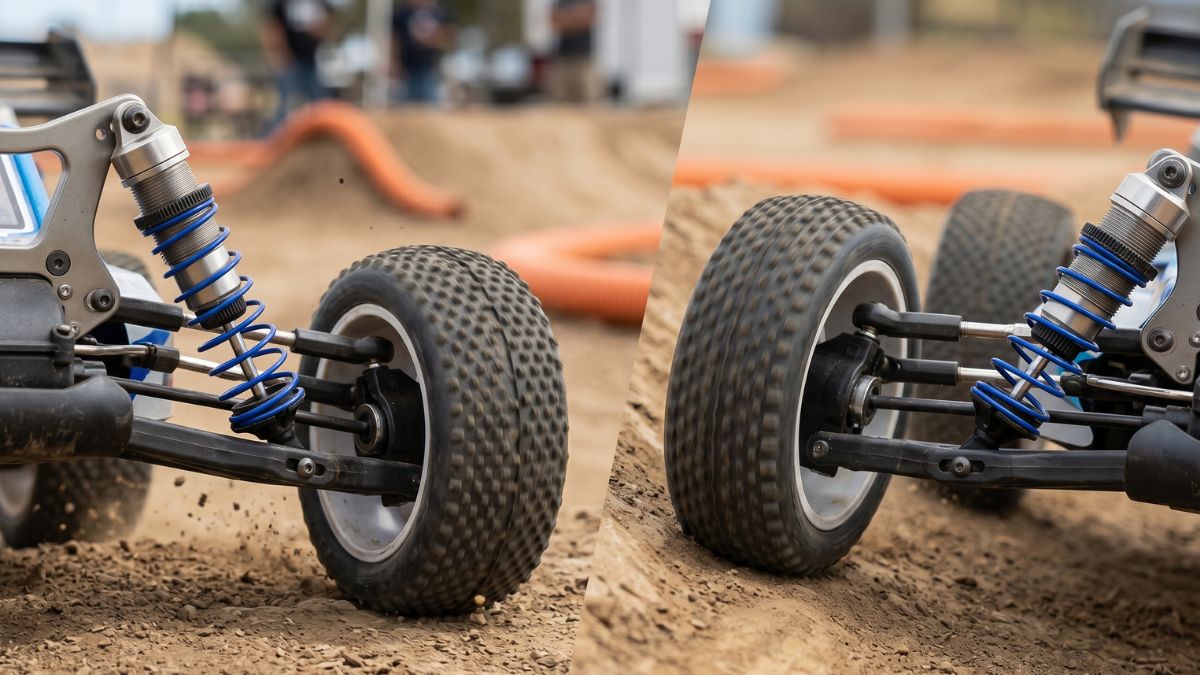
RC Suspension Basics: What Actually Makes a Rig Handle Better
Intro
If your RC bounces through corners, nose-dives off jumps, or feels twitchy over rough ground, suspension is usually part of the story.
This is one of those setups people feel on the track or in the yard long before they can explain it.
Good suspension does not make a car magical. It just helps the tires stay planted, the chassis stay settled, and the whole rig feel easier to drive.
The Core Idea (In Plain English)
RC suspension is there to control how the car reacts when the surface gets rough, the weight shifts, or the car lands hard.
At the basic level, you are working with a few big pieces:
- Shocks control movement
- Springs support weight
- Suspension arms let everything travel
- Geometry affects how the tires stay in contact with the ground
When suspension is working right, the car feels calmer. It tracks straighter, corners more predictably, and lands without acting like it wants to throw itself into the next zip code.
That is also why suspension and tire choice work together. If your setup still feels sketchy after basic suspension tuning, tire choice may be part of the problem too.
And if you are trying to decide how soft, sharp, or forgiving the whole car should feel, it helps to put suspension choices into context.
When This Matters (Use Cases)
Scenario 1
- You are bashing in a backyard with ruts, grass, and rough landings
- Suspension that is too stiff or too loose can make the car harder to control than it needs to be
Scenario 2
- You are trying to drive faster on a track or clean up your cornering
- A more settled chassis gives you more confidence and more consistency
Scenario 3
- Your car used to feel decent, but now it bottoms out, leans too much, or lands weird
- Worn shocks, tired springs, or slop in the suspension can quietly wreck handling over time
What to Look For / Key Considerations
- Check shocks for leaks, bent shafts, and rough movement
- Make sure left and right ride height are close and consistent
- Watch how the car lands after jumps instead of only how it looks sitting still
- Start with basic preload changes before chasing bigger setup changes
- Use thicker shock oil for more control, thinner oil for quicker movement
- Remember that springs hold the car up while shock oil controls how fast it moves
- Look for slop in rod ends, hinge pins, and suspension arms
- Match your setup to where you actually drive, not where the fast guys on another surface drive
Common Mistakes
- Cranking preload way up and calling it suspension tuning
- Assuming stiffer always means better
- Replacing springs before checking for leaking or badly worn shocks
- Ignoring suspension slop while chasing tiny shock oil changes
- Tuning around bad tires, bent parts, or loose hardware
Real Talk
Suspension tuning gets overcomplicated fast.
For most RC drivers, the biggest wins come from the boring stuff: fresh shocks, correct ride height, no leaks, no bent parts, and a setup that matches the surface.
You do not need to turn every bashing rig into a race program. You just want a car that feels planted instead of nervous. Get the basics right first, and the fancy tuning stuff starts making a lot more sense.
Keep Your Rig Dialed
- Use the Parts Finder to find parts that fit your exact RC
- Match grip with Choosing the Right RC Tires
- Compare goals in RC Bashing vs Racing Setup
Closing
Big power is fun.
Control is what makes it usable.
That is where suspension earns its keep.